Honest pricing note: All charter rates are indicative ranges (last verified June 2026) and vary by boat size, comfort level, group size and season — July to September and major holidays price at the top; final pricing is confirmed by proforma. Komodo National Park entrance, ranger and activity fees are set by the government, change periodically, and are paid separately per person per day — we explain them but do not collect them. Wildlife and weather cannot be guaranteed: we tell travellers what to expect, not what they want to hear. This is general information, not travel or legal advice. We are an independent Labuan Bajo charter concierge and coordinate vetted boats.
A komodo dragon tour is a guided visit inside Komodo National Park to observe wild Komodo dragons at close but controlled range, always accompanied by certified park rangers. On a private komodo dragon tour you charter your own speedboat or phinisi, then choose how long you trek on Rinca and/or Komodo Island for dragon viewing and photography. Private Komodo Charter is a Labuan Bajo–based charter concierge. We don’t run boats; we match you with vetted speedboat and phinisi operators and help you design a realistic, safe dragon-focused route through the park. —
What a Komodo Dragon Private Tour Actually Is
A “see komodo dragon private” experience means three linked elements, all in one day or over several days:
- Private boat (speedboat or phinisi) from Labuan Bajo
- Landing at a ranger station: Loh Buaya (Rinca) and/or Loh Liang (Komodo)
- Guided komodo dragon trek Rinca or Komodo with assigned park rangers
You are visiting a functioning national park with wild predators, not a zoo. Access, timings and trekking routes are controlled by:
- Balai Taman Nasional Komodo (park authority)
- Mandatory local rangers at each trekking post
Your charter gives you privacy and flexibility on:
- Departure time from Labuan Bajo
- Boat size and comfort level
- Whether you include only Rinca, only Komodo, or both plus snorkeling stops
Inside the park, the rangers and prevailing conditions decide how long each trek runs, which path is open, and how close you stand to individual dragons. —
Rinca vs Komodo Island: Which Dragon Trek Is Right for You?
Most visitors ask the same questions:
- “Where will I most likely see dragons?”
- “How long is the boat ride?”
- “Can I do Rinca and Komodo in one day?”
Here is a concise comparison based on current navigation times and park layouts.
| Aspect | Rinca Island (Loh Buaya) | Komodo Island (Loh Liang) |
|---|---|---|
| Typical boat time from Labuan Bajo (fast speedboat) | ~1.5 hours one way | ~2.5 hours one way |
| Typical boat time (traditional wooden / slower boat) | 2.5–3.5 hours | 3.5–4.5+ hours |
| Ranger station | Loh Buaya | Loh Liang |
| Dragon sighting likelihood | Very high around ranger area all year | High overall; more spread along trails |
| Main landscape | Mangrove fringe, dry savannah hills, coastal forest | Broader valleys, savannah hills, coastal woodland |
| Standard guided trek lengths | ~1 hour / ~2 hours / ~3 hours | ~1 hour / ~2 hours / ~3 hours |
| Peak heat months (harder trekking) | August–October | August–October |
| Best for short day trips | Yes – closer to Labuan Bajo | More demanding day, better in 2D/1N+ itineraries |
| Recommended for families with younger kids | Yes (short walking routes and quicker transit) | Yes for active families, but longer day on the water |
Both islands offer real, wild encounters. The difference is mostly logistics and the “feel” of the landscape.
Rinca Island: Shorter Transit, High Probability Viewing
Rinca is the practical choice if you want:
- A focused half-day or single-day dragon trip
- Less time on the boat, more time walking
- High likelihood of seeing multiple dragons near the ranger station
Key points:
- Transit: Around 1.5 hours by efficient speedboat from Labuan Bajo to Loh Buaya, depending on sea state and exact boat.
- Ranger station area: Dragons regularly bask around the wooden walkways and staff housing. It is common (not guaranteed) to see several individuals even before you start trekking.
- Landscape: Dry savannah hills with short climbs to viewpoints; some shaded sections, but large portions are exposed to sun.
For many guests, a komodo dragon trek Rinca plus 1–2 snorkel stops (for example around nearby reefs or sandbars) is the most efficient one-day itinerary from Labuan Bajo.
Komodo Island: Longer Day, Broader Habitat
Komodo Island is larger and feels more expansive. It is the better fit if you:
- Prefer a fuller “national park” experience with longer walks
- Are already planning 2D/1N or longer on a phinisi
- Don’t mind a longer ride (often 2.5 hours each way by speedboat)
At Loh Liang:
- Dragons may be seen near the ranger post, forest edge, or along the trek.
- Because there is more habitat, the dragons can be spread out; sightings can be clustered or more sporadic along the trail.
If you ask which is “better”, the honest answer is:
- For day-trippers: Rinca is usually the best balance of time vs. dragon viewing.
- For longer charters: Adding Komodo Island gives you a second, complementary encounter with a different feel and more spacious landscape.
—
How the Ranger-Guided Komodo Dragon Trek Works
Mandatory Rangers and Safety Briefing
On both Rinca (Loh Buaya) and Komodo (Loh Liang):
- Your boat moors at the jetty and you walk to the ranger station.
- Park entry and conservation fees are paid or verified. A licensed ranger is assigned to your group; this is included in the park fee structure.
- You receive a short safety briefing: how to walk in line, what distance to keep, and what to do if a dragon approaches.
You are not permitted to walk independently. Rangers carry a forked wooden stick — it is a tool to create distance, not a weapon. Your role is to listen, follow, and respect their instructions.
Short, Medium, and Long Trek Options
Each island usually offers three nominal trek durations:
- Short trek (~1 hour): Flattest, lowest effort loop, generally suitable for most fitness levels. Focused on areas with a historically high chance of komodo dragon viewing near the ranger zone and close forest.
- Medium trek (~2 hours): Adds some hills and viewpoints. More time in open savannah and forest edges, more chances to see dragons, deer, wild pigs, and birdlife.
- Long trek (~3 hours): For active walkers. More exposed sections, steeper inclines, and deeper into the dragons’ territory.
Two candid realities:
- Durations are approximate. Hot weather, group pace, and wildlife stops can extend or shorten the walk.
- Routes change. The park may temporarily close certain paths due to fire risk, conservation work, or dragon nesting activity.
On a private komodo island dragon private tour, your boat schedule is flexible, so you can pick a longer trek if conditions allow and you feel up to it. Park rangers make the final call on whether that’s safe and available on the day.
How Close You Actually Get to the Dragons
Komodo dragons are powerful, ambush predators, but they are not constantly active:
- They spend long periods basking, resting, or slowly wandering.
- In the middle of the day, especially in the hotter months, many individuals are quite still and appear docile.
Typical viewing distances:
- Rangers will usually keep guests ~5–10 metres away from large adult dragons.
- For smaller dragons or juveniles, they may ask you to stand further, as these individuals can be more skittish.
Photography:
- Telephoto zoom (70–200mm or similar) gives you frame-filling shots without needing to get close.
- Phone cameras are fine; rangers are used to positioning small groups for safe, sensible angles.
No ranger will ever promise a specific pose or distance. The priority is always: dragon first, guests second, photo third. —
Komodo Dragon Behaviour: What You’re Really Seeing
Ambush Predators, Not Performers
Komodo dragons are opportunistic hunters and scavengers. Key behaviours you may observe:
- Basking: Lying in open patches, mouth partially open to thermoregulate.
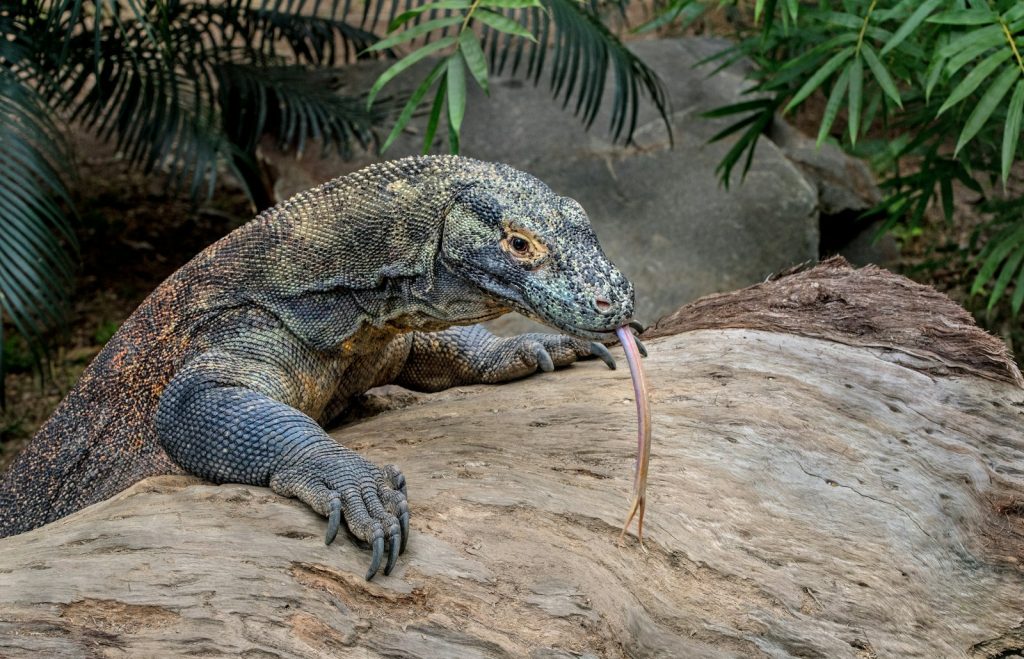
- Tongue flicking: Tasting the air to locate carcasses or potential prey.
- Slow roaming: Moving between shade and sun, or patrolling paths used by deer and wild pigs.
- Social spacing: Larger dragons may displace smaller ones from preferred spots.
Most tours take place in daylight hours, when dragons are least active. That’s intentional: it’s safer, and the heat naturally slows them down.
Seasonal and Daily Patterns
You will not see the same behaviour every month or even every hour. Influences include:
- Time of day: Early morning and late afternoon are cooler; dragons may walk more and use trails. Midday is hotter; they often rest in shade.
- Seasonal temperature: August–October can be extremely hot and dry; dragons are often more stationary for longer stretches.
- Breeding and nesting: Nesting females can be more defensive around their mounds. Rangers know where these sites are and will buffer guests.
There are no guarantees of seeing specific behaviours such as “hunting” or “running”. In most cases, you observe them as they live: quietly, sometimes uneventfully, in a harsh dry-island ecosystem. —
How to Book Rangers and What Park Fees Include
Ranger Allocation Process
You do not pre-book an individual ranger by name. The process is straightforward:
- Your captain or tour leader registers your group on arrival at Loh Buaya (Rinca) or Loh Liang (Komodo).
- Park staff collect the required entry, conservation, trekking, and camera fees according to the current official schedule.
- A ranger (or rangers, for bigger groups) is assigned to you for the trek, included in those park fees.
For private charter guests:
- You have control over when you arrive at each ranger station, within daylight and tide constraints.
- Your group usually treks without unrelated walk-in tourists mixed in, depending on how busy it is and park policy on the day.
Current Fee Structure and What Can Change
Komodo National Park fees have changed several times in the last decade and can be complex, involving:
- Park entry fees
- Conservation fees
- Trekking fees
- Camera or drone (where allowed) surcharges
Because these are set by the park authority and related agencies, they can be revised with limited notice. Different rules sometimes apply on weekends, public holidays, or for foreign vs. domestic visitors. We always:
- Use the official, published schedules at the time of planning.
- Clarify what is likely to be payable on the day, with a buffer for changes.
If you plan your trip with us via email or WhatsApp, we’ll walk you through the latest known ranges (last verified June 2026) and how they apply to your group size and planned route. —
Private vs Group Komodo Dragon Tour: What Actually Changes
Boat and Schedule Control
On a group day trip you share:
- Boat space
- Set departure and return times
- Fixed route, often compressed to “see everything” quickly
On a private komodo island dragon private tour arranged through a charter:
- Departure time from Labuan Bajo: You choose (within safe daylight windows). Early departures help avoid mid-morning crowding and heat on Rinca or Komodo.
- Time at each island: You can spend more time at the ranger station if dragons are active, or extend your walk if conditions allow.
- Additional stops: It’s easier to combine trekking with specific snorkel sites such as Siaba Besar or manta areas if currents and tides line up.
On-Trail Experience
Inside the park, the walk itself is still controlled by rangers, but a private setting can make a significant difference:
- Your questions and photo stops set the pace, as long as the ranger is comfortable with it.
- You avoid being rushed because a big group is stacking up behind you.
- Families can adjust for children’s attention span and comfort, rather than keeping up with strangers.
The dragons behave the same way; the improvement is in space, quiet, and responsiveness to your interests. —
Sample Private Komodo Dragon Tour Itineraries
These outlines are based on typical speedboat timings in normal sea conditions and average guest fitness. Exact schedules shift with tides, weather, and park directives.
1-Day Private Rinca Dragon Trek + Snorkeling (Speedboat)
- 06:30–07:00: Depart Labuan Bajo.
- ~08:30: Arrive Loh Buaya, Rinca. Fee processing and safety briefing.
- 09:00–10:00: Short trek, focusing on ranger area and nearby forest. Suitable if temperatures climb quickly or for younger kids.
- 10:00–11:00: Walk around the boardwalk area, observe dragons near ranger buildings if present, take photos.
- 11:00–12:00: Cruise to a nearby snorkel site or sandbar.
- 12:00–13:00: Snorkeling and lunch on board.
- 13:00–14:30: Optional second snorkel or relaxed return.
- 15:30–16:00: Back in Labuan Bajo.
This suits travellers who prioritise komodo dragon viewing but also want a taste of the marine side of the park without a very long day.
1-Day Rinca + Komodo Dragon Double Trek (Fastest Speedboat Only)
This is a long, intensive day; viable only with a genuinely fast, well-operated speedboat and in cooperative sea conditions.
- 06:00: Depart Labuan Bajo.
- ~07:30–08:00: Rinca (Loh Buaya) arrival, short or medium trek.
- 10:00: Depart for Komodo Island.
- ~11:30–12:00: Komodo (Loh Liang) arrival, short trek; focus on variety rather than distance walked.
- 14:00: Depart Komodo.
- ~16:30–17:00: Return Labuan Bajo.
You trade relaxed snorkeling and beach time for two separate dragon encounters. We only recommend this to fit, motivated travellers, and only if tides, weather, and vessel quality align.
2D/1N or Longer Phinisi Charter with Dragon Focus
A multi-day phinisi itinerary typically:
- Visits either Rinca or Komodo on Day 1 for the main trek.
- Uses cooler morning or late afternoon windows for trekking.
- Spreads snorkel and island stops (Padar viewpoint, Siaba Besar, manta sites) across the rest of the schedule.
Advantages:
- Shorter individual days and more recovery time between walks.
- Higher chance that at least one trek lands in cooler, more comfortable conditions for both guests and dragons.
If you’d like a personalised route that balances dragon viewing, manta rays, and reef highlights, you can plan your trip with us by sharing your dates and priorities via email or WhatsApp. —
Fitness, Safety, and Practical Tips for Komodo Dragon Viewing
Who Can Join a Komodo Dragon Trek?
The short trek on both islands is generally manageable for:
- Adults with basic mobility
- Active older travellers
- Children who are comfortable walking 1–2 km in warm conditions
Consider:
- There are some uneven, dusty paths and small inclines.
- Heat and humidity can be intense, particularly July–October.
- There is no air-conditioning on the trail; shade is limited on ridges.
Discuss any significant mobility or health concerns in advance so we can advise on realistic route choices and best time of day.
Safety Rules with Dragons
Rangers repeat these on arrival; they are non-negotiable:
- Stay behind the ranger and keep the group together.
- Do not approach dragons on your own, even if they appear asleep.
- Keep a respectful distance, especially from nesting sites and juveniles in trees or undergrowth.
- No food in open pockets or hands; dragons have an acute sense of smell.
- Parents keep children next to them, not running ahead or behind.
Komodo incidents are rare but serious when they happen. Their unpredictability is exactly why guided access is compulsory.
What to Wear and Bring
To stay comfortable and safe:
- Footwear: Closed shoes with grip (trail shoes or trainers). Avoid flip-flops.
- Clothing: Lightweight, breathable fabrics; long sleeves and long pants help with sun and brush.
- Hat & sunglasses: Essential on exposed ridges.
- Water: At least 1 litre per person for even the short trek.
- Sun protection: High-SPF reef-safe sunscreen, applied before landing.
Camera gear should be secure and manageable; changing lenses in dusty, windy conditions can be challenging. —
Weather, Tides, and Why Sightings Are Never Guaranteed
Seasonality in Komodo National Park
Komodo sits in a transition zone between the Indian and Pacific Oceans with a pronounced dry season. Broad patterns:
- December–March: Higher chance of rain and squalls; seas can be rougher, especially in open stretches.
- April–June: Often a very good compromise of visibility, greener hills, and relatively calm seas.
- July–October: Drier, very hot on land; seas can be windier in certain channels.
- November: Transitional; can be excellent, but conditions vary year to year.
Rinca and Komodo treks operate year-round, subject to temporary closures or route changes for safety, fire risk, or conservation work.
Tides, Currents, and Landing Windows
While dragons live on land, the only way to reach them is by sea, and tide and current behaviour around the park is complex:
- Strong tidal currents in the main channels can slow crossings or dictate which side of an island is used for approach.
- Jetty heights vs. boat decks can affect the comfort of boarding and disembarking, especially for children or older travellers.
- Rarely, very rough conditions can make certain landings impractical, shifting the day’s route.
We design itineraries around realistic crossing times and conservative weather assumptions, but final decisions always rest with the captain and, inside the park, with rangers.
Why We Don’t Promise “Guaranteed” Sightings
Rinca has an excellent track record: many days see multiple dragons around the ranger station alone. Komodo Island also regularly delivers quality encounters. But any operator claiming a 100% guarantee of a specific viewing – “you will see 10 dragons” or “you will stand 2 metres away” – is overselling. Variables include:
- Day-to-day dragon movements and activity levels
- Temperature and rainfall patterns in the weeks before your visit
- Temporary park management decisions on feeding, waste handling, and human–dragon interaction rules
We can say:
- Rinca: sightings are very likely on a standard trek.
- Komodo: sightings are likely, but individuals may be more spread out.
We cannot promise exact numbers, poses, or distances. That uncertainty is part of travelling to see truly wild animals. —
Costs, Boat Types, and How We Help You Choose
Speedboat vs Phinisi for Dragon-Focused Trips
Most private dragon tours use one of two boat categories:
- Private speedboat
- Fast transit, ideal for 1-day trips. You trade cabin space and relaxed cruising for efficient crossings and more time on the islands.
- Private phinisi (traditional-style liveaboard)
- Slower but more spacious, with cabins and shaded decks. Best for 2D/1N and longer itineraries combining dragons, snorkeling, and diving.
We work with a range of vetted operators across sizes and comfort levels. Exact options depend on your dates, group size, and budget.
Price Ranges (Last Verified June 2026)
Because multiple agencies and regulations influence costs in Komodo, any honest guide must talk in ranges, not fixed numbers. Expect to budget for:
- Private speedboat charter: Typically from mid-range to premium pricing for a full-day, depending on capacity, engine power, and season.
- Private phinisi: Priced per day or per night, varying widely by vessel size, cabin standard, inclusions, and group size.
- National park fees: Per-person, per-day charges incorporating entry, conservation, trekking, and other levies.
If you share your group size and target dates, we can outline a realistic cost envelope and match you to specific boats that fit. If you proceed with our partner they may pay us a referral fee at no extra cost to you. —
Planning Your Own Komodo Dragon Private Tour
To get the most from a komodo dragon tour focused on Rinca and/or Komodo Island:
- Decide how many days you want inside the park.
- Clarify what matters most: dragons only, or dragons plus snorkeling/diving.
- Be honest about your group’s fitness and heat tolerance.
- Give us a window rather than a single fixed day if possible; that makes it easier to align boats and tides.
From there we:
- Suggest Rinca-only, Komodo-only, or combined routes based on your timeframe.
- Recommend speedboat or phinisi options that match your comfort level.
- Outline current park fee structures and practical timing (departures, returns, trekking windows).
To start, plan your trip via the form, or reach out on WhatsApp with your dates, group size, and priorities and we’ll respond with specific, candid options rather than generic packages. —
FAQs: Komodo Dragon Private Tour
Is Rinca or Komodo Island better for seeing dragons?
Rinca (Loh Buaya) usually offers a higher probability of seeing multiple dragons near the ranger station within a shorter trek, and it’s closer to Labuan Bajo, which makes it ideal for one-day trips. Komodo (Loh Liang) has more extensive habitat and a different feel, but dragons can be more spread out. For limited time, Rinca is often the more efficient choice; with 2 days or more, combining both is rewarding.
Can I do both Rinca and Komodo Islands in a single day?
It is technically possible with a fast, well-operated private speedboat, light snorkeling or no snorkeling, and cooperative sea conditions. It makes for a very long, intensive day with early departure and late return. For most travellers, we recommend choosing one island for a focused day, or using a 2D/1N+ phinisi charter to visit both at a more comfortable pace.
How likely am I to see Komodo dragons on my tour?
On Rinca, sightings on standard treks are very likely; many days you’ll see several individuals near the ranger area and along the trail. On Komodo Island, sightings are also likely but can be more spread out. That said, these are wild animals in a real ecosystem, so no operator can honestly guarantee a specific number of dragons or a particular viewing distance.
Is a komodo dragon tour suitable for children?
Yes, many families visit with school-age children. The short treks are manageable for most kids who are used to walking and heat, and rangers are experienced in guiding families. Parents must keep children close and follow all instructions. For very young children or those sensitive to heat, an early-morning Rinca visit with a short trek is usually the most comfortable option.
What should I wear and bring for the trek?
Wear closed shoes with good grip, lightweight long sleeves and long pants if possible, a hat, and sunglasses. Bring at least 1 litre of water per person, reef-safe sunscreen, and a simple daypack. A camera or phone with a decent zoom helps, but avoid carrying more equipment than you can comfortably manage on uneven, occasionally steep terrain.